Digital Leadership – a ZEIT Akademie seminar
Also in: Deutsch
At ZEIT Akademie I came across the seminar “Digital Leadership”. I soon realised that it dated from 2018 – so it was already a few years old.
Looking back at a look ahead
The seminar is about digital transformation and how to make organisations fit for change. It therefore offers insight into the situation in 2018 and, at the same time, a view of the future as seen back then.
In the end it was more than just an interesting retrospective.
Advancing digitalisation
Different industries naturally go through digitalisation at different times.
That sounds perfectly logical – but while I was in the middle of it, I lacked the bird’s-eye view. In 2018 I moved from the logistics industry to insurance, and the first thing I noticed was the complete absence of a ticketing system. Seriously???
In the seminar, Dr. Willms Buhse says that in 2018 it is the turn of banks and insurers, whereas I had assumed everyone was at the same level. No wonder so few of the best practices I knew had arrived there.
I only became fully aware of this in hindsight, when I saw the following chart.
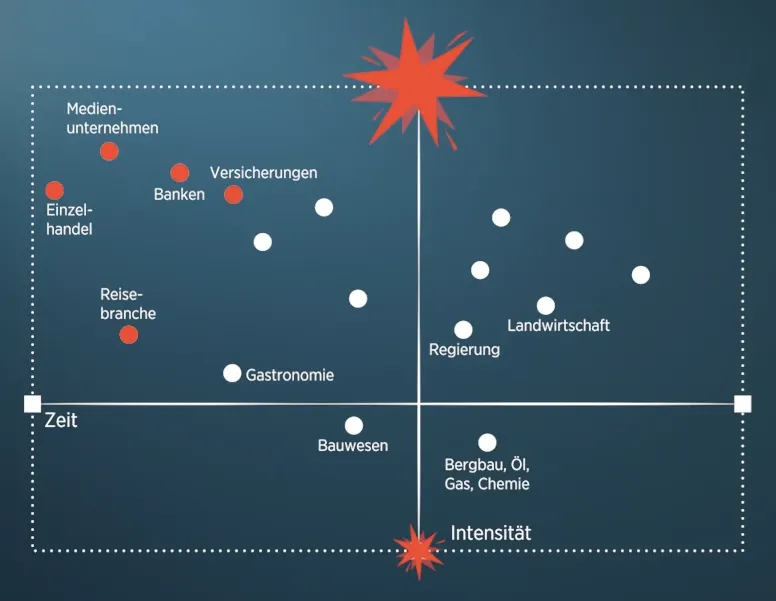
Disruption map in the seminar (source: Heads! and Deloitte Digital, 2015; graphic: ZEIT Akademie)
Lessons
The questions around digital transformation have not changed:
- What skills do leaders need?
- How do we restructure the organisation?
- Which working methods are suitable?
The seminar answers them in six lessons that build on each other but can also be watched individually. Four lecturers guide through the lessons, complemented by interviews with practitioners such as Frank Thelen, Miriam Wohlfarth, Timm Richter and Prof. Dr. Niels Van Quaquebeke.
| Lesson | Title | Lecturer | Focus |
|---|---|---|---|
| 1 | Managing the digital transformation | Dr. Willms Buhse | Situation, fields of action, business models |
| 2 | The core competencies of a digital leader | Dr. Willms Buhse | Role and mindset of the leader |
| 3 | From an analogue to a digital organisation | Dr. Christian Böing | Structure, change process, culture |
| 4 | Negotiating in the digital age | Matthias Schranner | Negotiation team, phases, communication |
| 5 | Agile management methods | Dr. Christian Böing | Agile working and Scrum |
| 6 | Trends and developments | Nikolaus Röttger | AI, Internet of Things, blockchain, AR/VR |
If you want a quick start, begin with lessons 1 and 2 to get your bearings. For the actual restructuring, lessons 3 and 5 are the most rewarding. Lesson 4 is worthwhile before an upcoming negotiation, and lesson 6 is a self-contained technology overview.
Concepts and tools
Lesson 1: Managing the digital transformation
Concepts
- VUCA world: volatility, uncertainty, complexity and ambiguity – an environment in which long-term plans hardly hold.
- Disruption: business models that can be digitised are not improved but replaced – sooner or later, more or less strongly, depending on the industry.
- Digital mindset: all employees understand what the change means for their own work.
- VOPA: networking, openness, participation and agility (German: Vernetzung, Offenheit, Partizipation, Agilität) as success factors on the way from hierarchy to network.
“The biggest challenge for management in the digital transformation is that things are actually going well at the moment.” – Frank Thelen (translated)
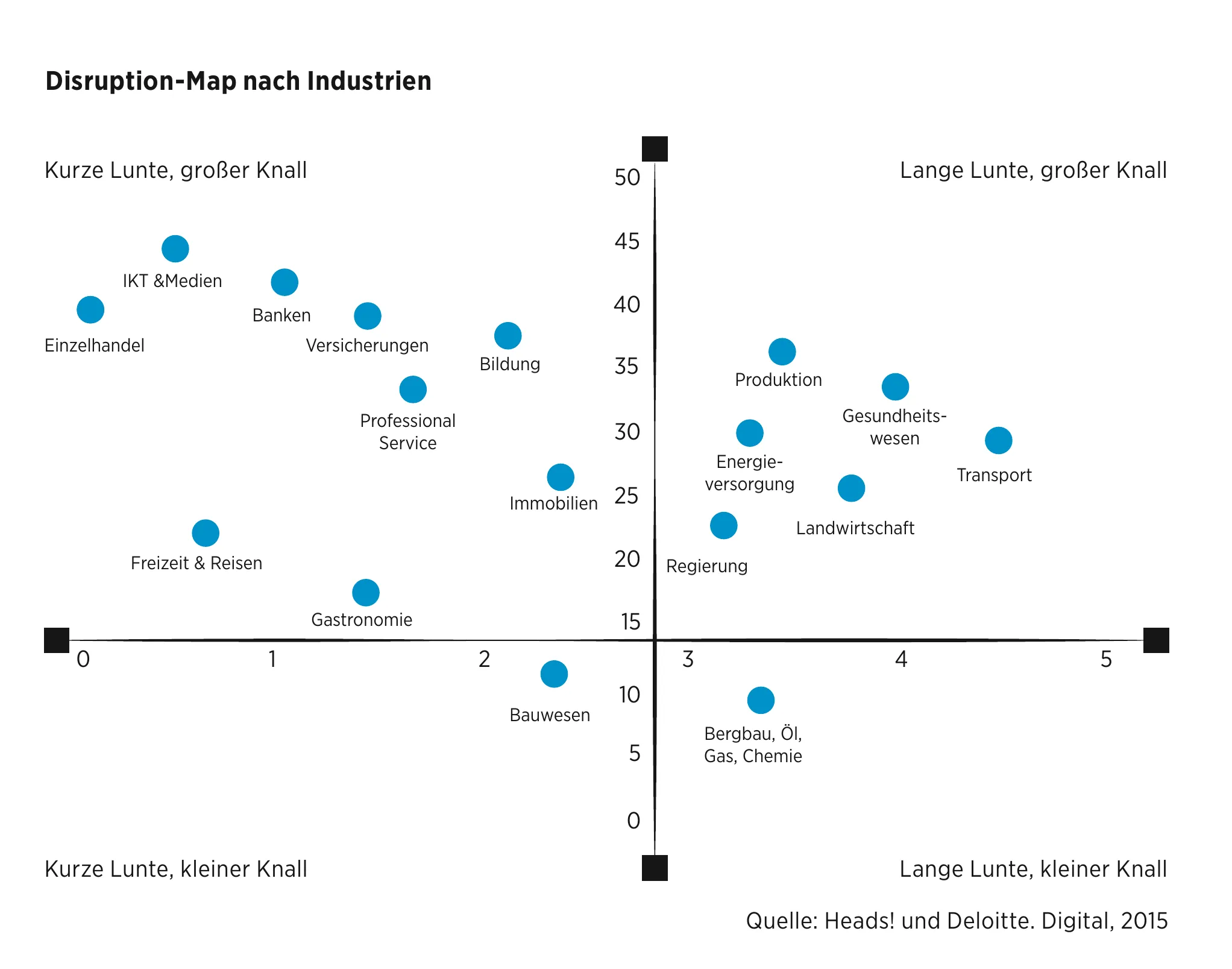
Disruption map by industry (source: Heads! and Deloitte Digital, 2015; graphic: ZEIT Akademie)
Tools
-
Disruption map: how soon and how strongly will change hit your own industry?
-
Wheel of digital transformation: eight fields of action as a checklist:
Digital … strategy ➞ customer relationships ➞ products & services ➞ processes ➞ social collaboration ➞ mindset ➞ transformation management ➞ leadership
-
Business Model Canvas: nine fields for describing your own business model and playing through new ones.
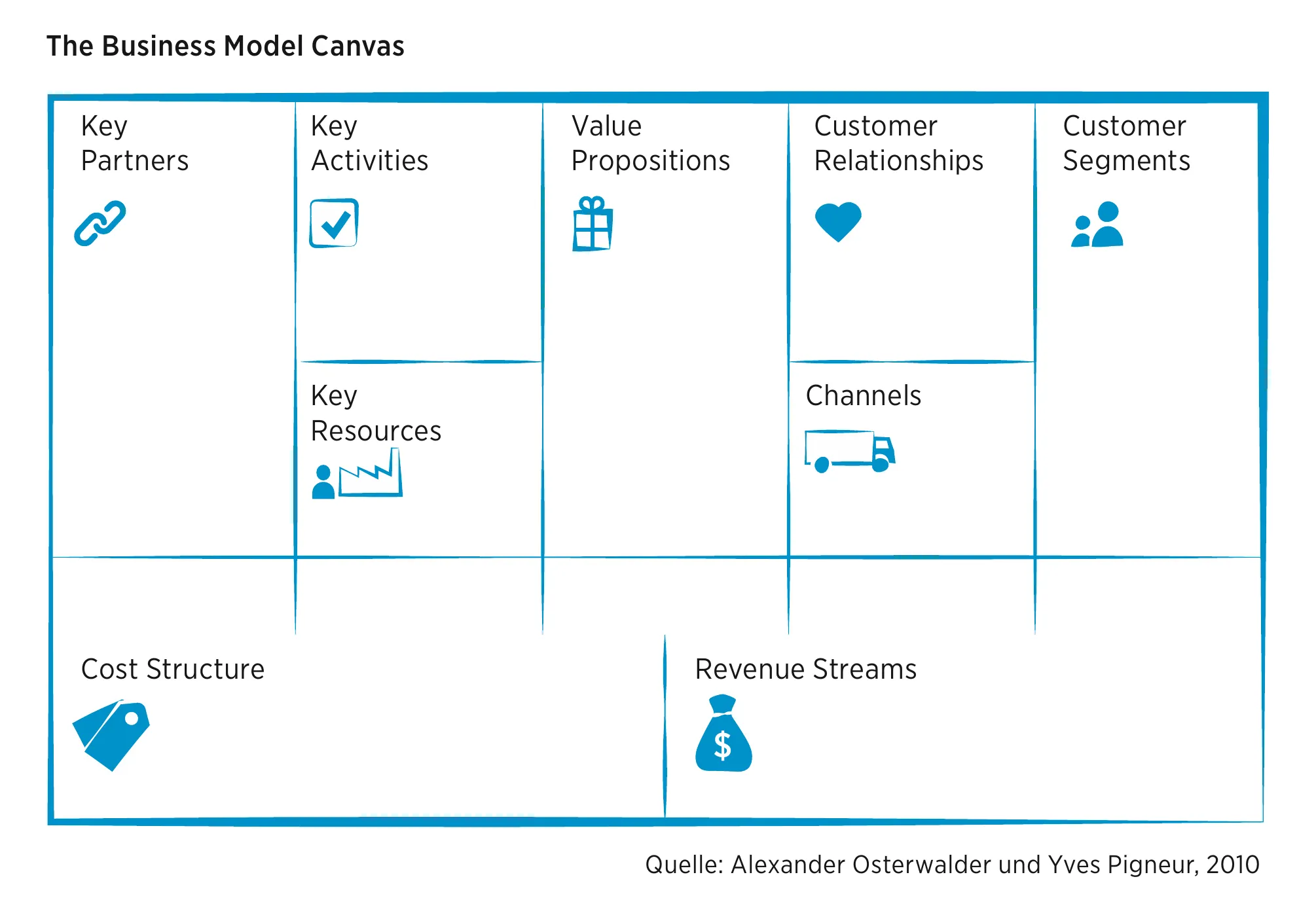
The Business Model Canvas (source: Alexander Osterwalder and Yves Pigneur, 2010; graphic: ZEIT Akademie)
Lesson 2: The core competencies of a digital leader
Concepts
- Self-image and external image: leaders rate their digital competence considerably higher than their employees do.
- Paper natives and digital natives: two sets of values – quality and security versus speed and openness. Neither is better in principle.
- Hierarchy and network: both have their place; the art lies in switching between them.
- Agility as a discipline: agile does not mean chaotic, but delivering usable, high-quality results early and regularly.
- MVP: minimum viable product, working prototypes.
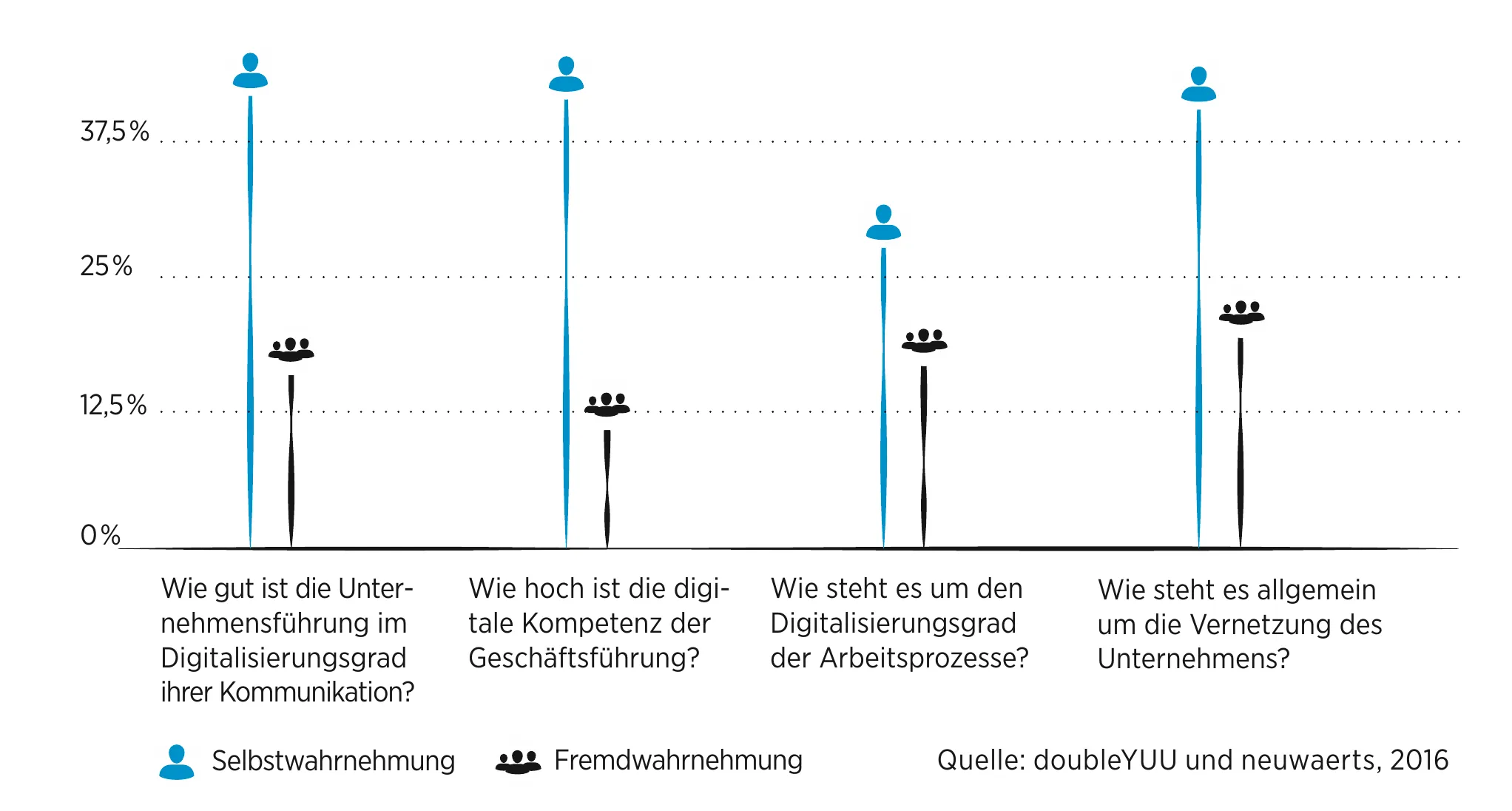
Self-perception and external perception of company management (source: doubleYUU and neuwaerts, 2016; graphic: ZEIT Akademie)
Tools
- Ansoff matrix: where are classic methods sufficient, and where are new ones needed?
- Strategic slider (Bosch): choosing the right leadership pattern for each situation.
- Jeff Bezos’s decision rules: lightweight processes for reversible decisions, get going with 70 per cent of the information, “disagree and commit”.
- FedEx Day: for 24 hours, everyone involved works undisturbed on a deadlocked problem; at the end there is a decision everyone supports.
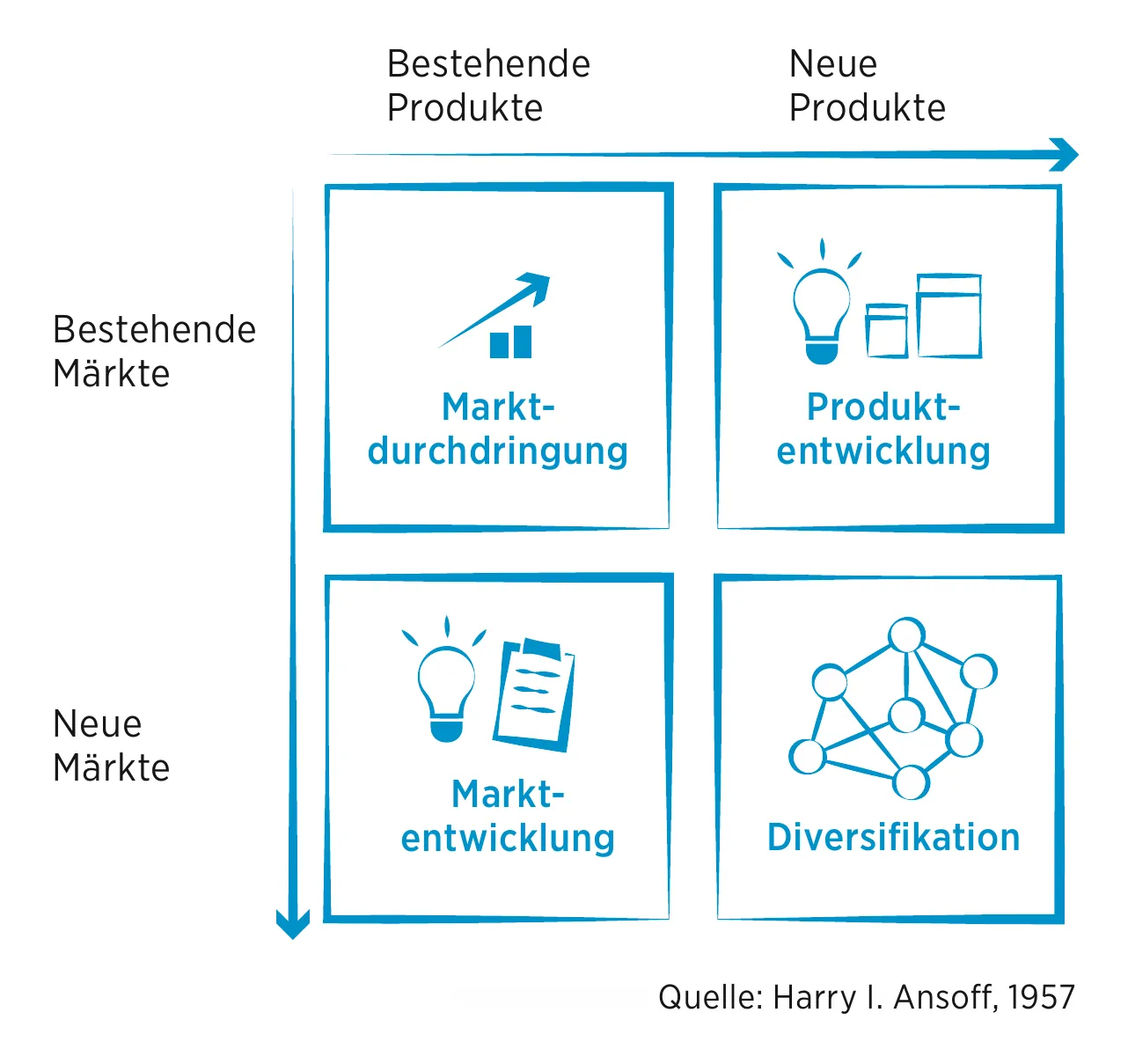
Ansoff matrix (source: Harry I. Ansoff, 1957; graphic: ZEIT Akademie)
Lesson 3: From an analogue to a digital organisation
Concepts
- Speed before efficiency: better a little more expensive but faster.
- Business units instead of functions: many small companies within the company.
- Criticism of the Chief Digital Officer: anyone who needs a CDO permanently has not yet completed the restructuring.
- Culture as glue: delegation, trust and direct communication replace reporting lines and politics.
Tools
- Product-centred teams and lighthouse projects: a gentle start alongside the existing structure.
- Edgar Schein’s levels of culture: distinguishing visible behaviour, values and unconscious basic assumptions.
- Over-communication and incentives: accompanying the change constantly and making it worthwhile for everyone.
Lesson 4: Negotiating in the digital age
Concepts
- Conflict with dependency: that remains; media, pace and transparency change.
- Preparation as a source of power: the negotiation begins long before the first meeting.
- Three principles: trust before content, primacy of the agenda, a deliberate mix of media.
Tools
- FBI model: decision maker, commander and negotiator with clearly separated roles.
- Research checklist: who is the other party, are they allowed to decide, who influences them?
- Negotiation funnel: information phase, digital preliminary talks, face-to-face negotiation.
- Agenda and summary email: setting the structure and recording the current status in writing.
Lesson 5: Agile management methods
Concepts
- Waterfall versus agile: a fixed overall plan only suits stable undertakings.
- Agile Manifesto: people, working results, customer collaboration and responding to change come first.
- Servant leader: the leader sets the goals, the team decides on the way.
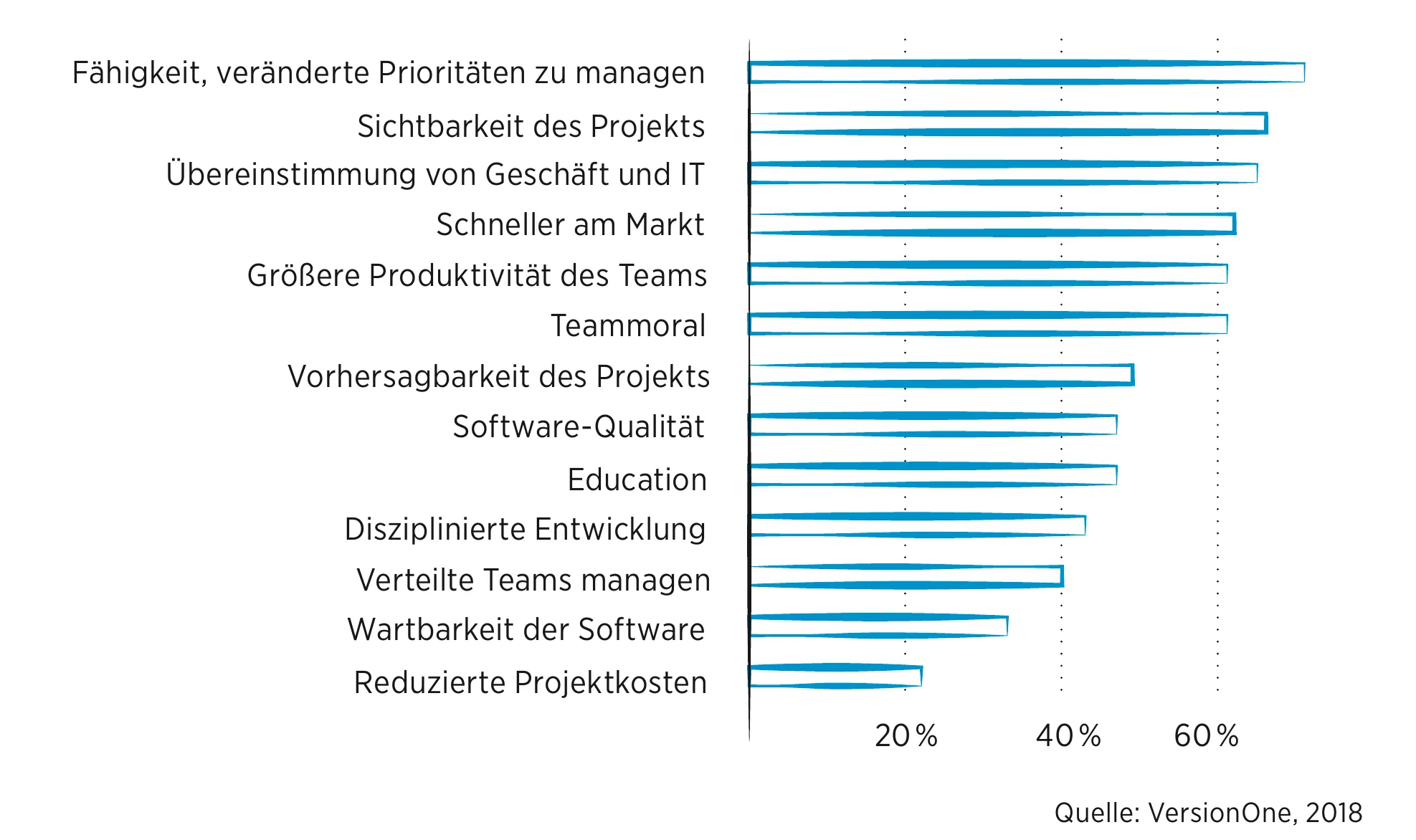
Benefits of agile management (source: VersionOne, 2018; graphic: ZEIT Akademie)
Tools
- Backlog, stories and sprints: breaking undertakings into small steps and implementing them in fixed cycles, each with a retrospective.
- Prototype and minimum viable product: showing something that works early on.
- Daily stand-up and company board: daily alignment and a status visible to everyone.
- Scrum roles: product owner, cross-functional team, Scrum Master as coach.
Lesson 6: Trends and developments
Concepts
- Exponential growth: technology becomes more powerful and cheaper at the same time; people who think linearly underestimate this.
- AI, Internet of Things, blockchain, AR/VR: the trends reinforce each other.
Tools
- Chessboard image: explains to the team why linear forecasts are misleading.
- Focus rule: only follow the technologies that are decisive for your own business.
Conclusion
Many of the seminar’s figures and examples are now out of date. The models, on the other hand – from the Business Model Canvas and the Ansoff matrix to Scrum – are still in common use and can easily be applied to today’s situation.